

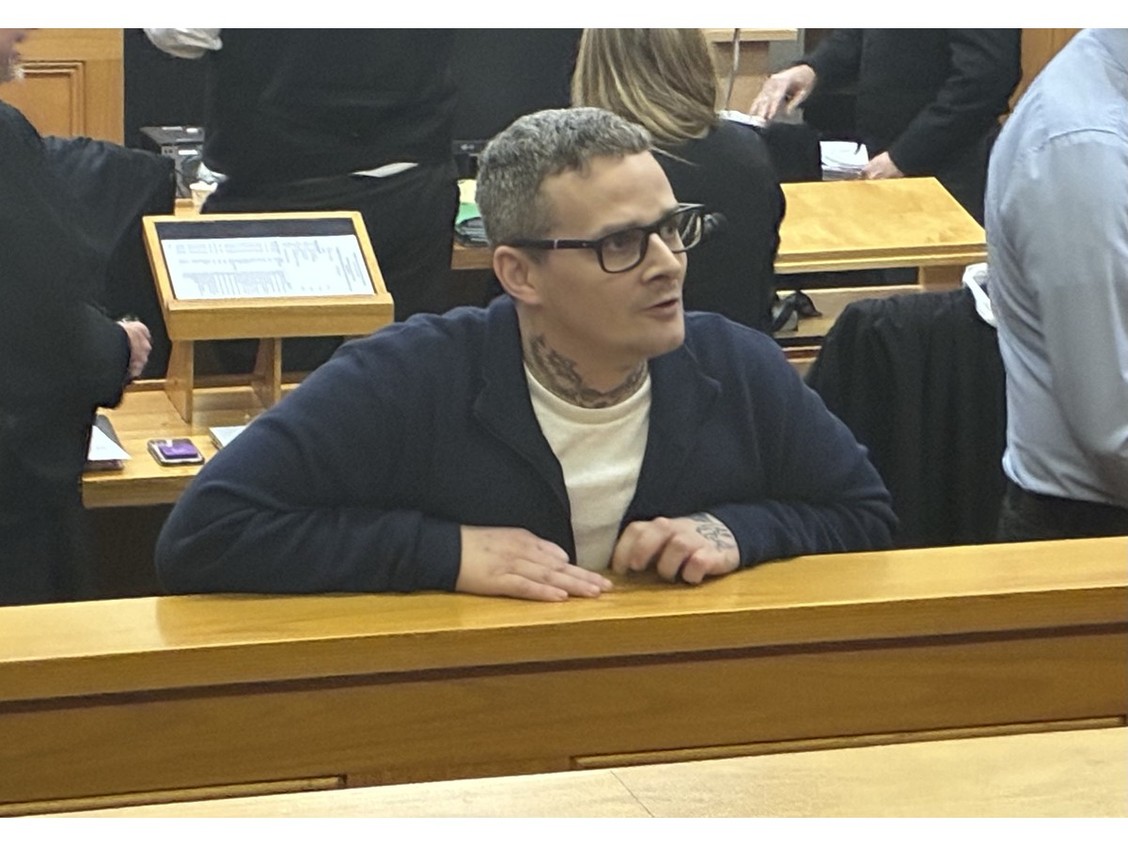
Terry Cole spent nearly five hours denying he had anything to do with the murder of Michael Fillier before he told the RCMP officer interviewing him, through tears, that he knew who was involved.
“I wasn’t supposed to talk,” Cole said to Cst. Daniel Gillingham between sobs, telling the officer his co-accused, Matt Kavanagh, was the one to kill Fillier in September 2024.
“He took it that far, did he?,” Gillingham replied. “You’ve done the right thing, Terry.”
He pressed Cole for details, telling him the past is the past.
“I need you to tell the truth,” the officer said.
“Will that get her off with murder?” Cole replied, referring to his girlfriend and third co-accused, Stephanie Noftall.
“I can’t promise you that,” Gillingham answered.
Cole was in a police interview room Oct. 6, 2024, a week after 42-year-old Fillier’s body was found in a burning truck on a dirt road in Bay Roberts. He, Noftall and Kavanagh were arrested the night of Oct. 5 at a house in Harbour Grace and charged with first-degree murder and committing an indignity to a human body.
Cole reportedly refused to cooperate when officers tried to speak with him after his arrest, but apologized for his behaviour the next morning. After speaking with a Legal Aid lawyer, he sat down with Gillingham, who explained his rights and asked him questions to ensure his understanding.
Video of the interview was played in Newfoundland and Labrador Supreme Court at the trio’s trial in St. John’s this week.
“Were you involved in the death of Michael Filler in any way?” Gillingham asked.
“No,” Cole replied.
“Do you know who was?”
“No,” Cole answered. “I don’t even know who Michael Fillier is.”
Over the next few hours, with several cigarette breaks, Gillingham built a rapport with Cole, asking him about his friendship with Kavanagh and his relationship with Noftall, whom Cole said he had been dating for about five years.
Cole said he and Noftall both struggled with addictions, and he described Noftall as the love of his life.
“We had four years of complete sobriety and it was the best four years of my life. She slipped and I slipped, and here we are, up on a murder charge,” Cole said, crying. “It’s like a fever dream, it doesn’t even make sense.”
He told the officer he hadn’t left the house where he was staying at all on the day of the murder and the day before, spending time smoking crack, watching music videos, doing yard work and playing with his friend’s dogs. Nothing out of the ordinary happened, he said.
Cape Breton Eagles to file complaint with QMJHL after on-ice incident against Newfoundland Regiment
 Cape Breton
Promising football player from Halifax dies at U.S. boarding school
 Halifax
RCMP charges man following numerous crimes targeting communities in southwest Nova Scotia
 Annapolis Valley
Bobcat makes unexpected visit to Dartmouth backyard
 Halifax
Fundraiser started to support family of Antigonish County farmer who died in tractor collision
 Nova Scotia
He told Gillingham he had heard Fillier was “an asshole” who sold drugs, but knew nothing else about him and had never met him.
“If you put me in a room with him, I wouldn’t be able to tell you who he is,” Cole said.
Gillingham left the interview room for extended periods at several points, and told the court Thursday it was to chat with investigators on the murder file, who were monitoring the interaction. Gillingham said he was not aware exactly how Fillier had been killed at that point.
Cole changes story
A few hours in, he returned to the interview room with an image of Cole captured by CCTV footage at a Bay Roberts gas station shortly before the burning truck was found.
Cole said he remembered leaving the house that day after all, and stopping to get gas with Kavanagh before going to buy drugs from his friend.
Gillingham showed Cole an image of Noftall at the Tim Horton’s location attached to the gas station, around the same time. Cole said he remembered picking her up after they got gas.
“In situations like this, there are people who have something to do with it, or everything to do with it,” Gillingham said. “The people who have something to do with it, perhaps they were there, or perhaps they drove. Perhaps they saw it happen. They kind of got roped into it once it started.
“Then there’s the (people who have) everything to do with it. (They are) the planner. They’re cold-hearted; they’re going there to do that. Honestly, I’m hoping that you’re not that person.”
Gillingham suggested something had happened between Fillier and Noftall, and Cole stepped in to protect her.
“I had nothing to do with the death of Michael Fillier,” Cole repeated several times. “I did not kill anybody.”
Officer confronts accused with evidence
Gillingham read from a report given to him by investigators with a run-down of the evidence collected from CCTV cameras and witness statements.
At 5:45 a.m. on Sept. 30, Fillier drove a blue Chevy Colorado pickup into the parking lot of the gas station and Needs store on L.T. Stick Drive with a passenger, believed to be Noftall, aboard. After pumping gas and going inside to buy snacks and dog food, he got back into the truck and parked it at far end of the lot.
About an hour later, a gray Honda Civic pulled up. A male passenger, whom investigators say was clearly Cole, went into the store, constantly looking out the window as he paid cash for gas and left. The Civic then pulled in next to the truck.
There was movement back and forth between both vehicles, Gillingham said, before Noftall was captured leaving the area and walking into the Tim Horton’s, spending five minutes in the washroom and leaving. The truck and car then left the parking lot, heading toward Country Road, where the burning truck was found by a passerby minutes later. Fillier’s body was inside.
Cole said he and Fillier had argued about Noftall, who left the truck and went into the restaurant when she got upset. He said he and Kavanagh bought drugs from Fillier and followed him to Country Road to complete the deal.
While there, he said, a Toyota Camry pulled up. He didn’t know the people inside.
“When I left, Mike Fillier was very much alive,” Cole told Gillingham.
The officer told him there wasn’t enough time for someone else to get involved. He said witnesses had told police Cole had gotten upset over a situation involving Fillier and Noftall, and had made a comment about revenge, telling Noftall, ‘You will no longer have to deal with Fillier.’
“What does that mean?” Gilligham asked Cole.
“This is all speculation,” Cole replied. “Circumstantial at best.”
Gillingham said witnesses had also mentioned a threat Fillier reportedly made to Noftall about her child, and told Cole he, personally, would have done anything to protect his own daughter if he were in that situation.
“You had to act, didn’t you?” he asked.
“I did not kill Michael Fillier,” Cole replied. “I felt a lot of things, but I did not kill anybody. … I’m not going to jail for 20 years to life with no chance of parole for killing someone I didn’t kill.”
‘You can tell the truth’
Later, Cole began sobbing when Gillingham told him he, Noftall and Kavanagh were “up to here in evidence.”
“How do I get Steph out of this? There has to be a way?” Cole asked.
“You panicked, didn’t you?” the officer replied. “You can still do the right thing and be the good person I know you are. You can tell the truth.”
“I need to know what happens with me and Steph,” Cole said, crying, and telling the officer, “I don’t want to hurt Matt.”
He eventually told Gillingham Kavanagh killed Fillier, and said he’d give police the details if they’d give him some assurance that he and Noftall “were safe.”
Gillingham told the court he and the investigators chose to end the interview at that point, saying they weren’t comfortable with Cole’s efforts to make a deal with them.
His audio recorder kept rolling, however, as he escorted Cole outside for a cigarette, where Cole asked where Noftall was and if she had been interviewed yet.
“I’m the idiot that actually said something,” Cole told the officer.
“You told the truth. Your morals still remain, even in this bad situation,” Gillingham said in the discussion. “I got a lot of respect for you.”

Confession can’t be used against co-accused
Justice Irene Muzychka has already instructed the jury on the limited way they can use out-of-court statements made by people jointly accused of a crime.
Generally, a confession can only be used as evidence against the person who gave it, not anyone else accused. That means jurors are only able to use Cole’s evidence to decide whether he is guilty of first-degree murder, not Kavanagh or Noftall.
Recordings of Kavanagh’s statements to police were played for the jury earlier at trial. He told police he had nothing to say, after being advised by his lawyer not to talk to them.
The trial continues Friday with cross-examination of Gillingham by Cole’s lawyers, Courtney Mills and Jason Edwards.
Prosecutors Colin Sheppard and Alex Marshall have indicated Gillingham is their final witness. Next, it will be the defence’s turn to present evidence.


 Pinterest
 Tumblr