
The colour of most stars is temperature-dependent.
Typically, when one looks at a star from here on Earth, it generally appears white, yellow, or orange-red, although some stars, when viewed in binoculars or telescopes, may also show a pale, colourful hue.
Interestingly, despite what one would anticipate, white-blue stars are actually the hottest, while those with an orange-red hue are the coolest.
Stellar colours vary, depending on their temperature and atmospheric composition. Overall, stellar colours resemble those of ideal thermal emitters, referred to as black bodies — idealized physical bodies that absorb all incident electromagnetic radiation.
Some white dwarf stars, on the other hand, buck the typical star-colour trend, appearing in a variety of different colourful hues, including green, pink, purple, yellow and cyan.
White dwarf stars are the dense core remnants left behind when a star like our own sun has exhausted all its nuclear fuel and throws off its outer layers. The remaining stellar material collapses inwards on itself, compressing into a body roughly the size of the Earth.

A green star?
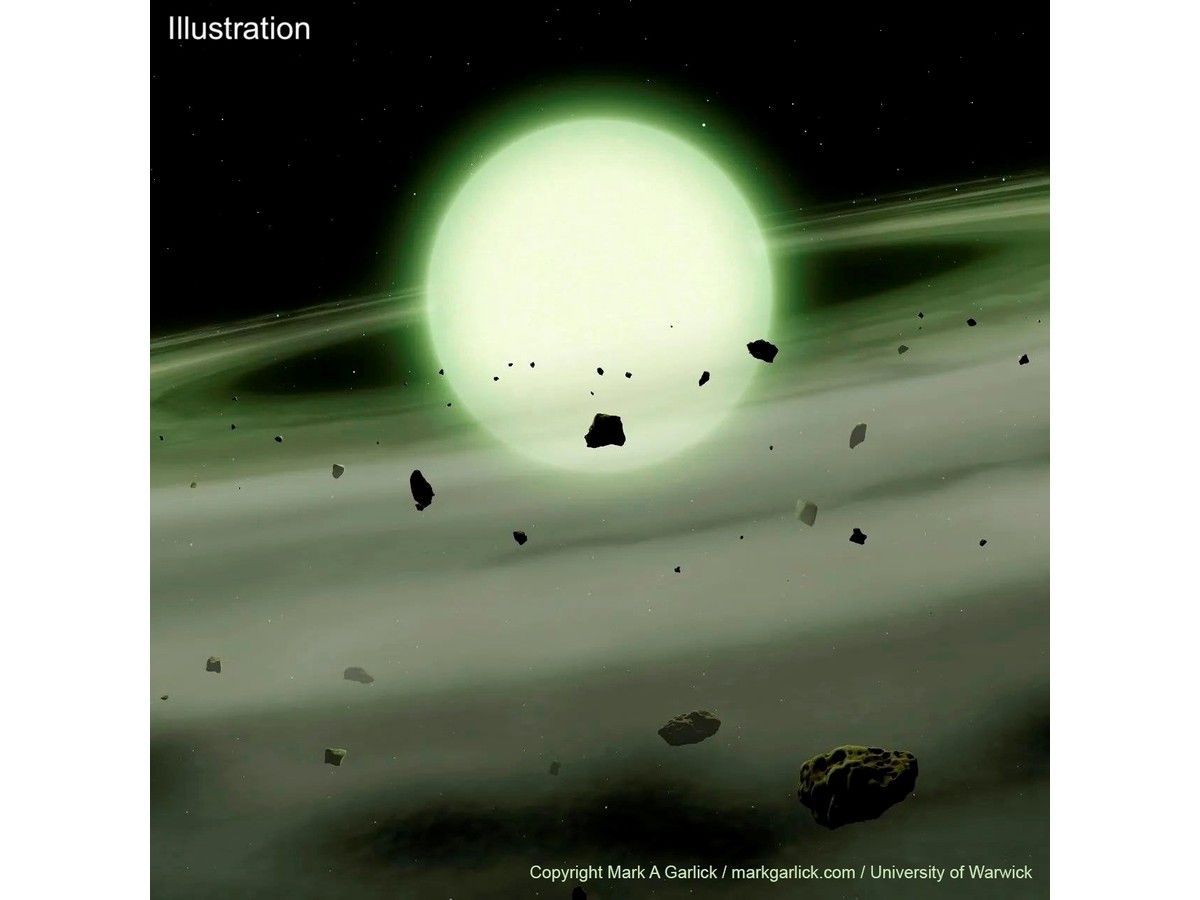
Astrophysicists working at the University of Warwick, in Coventry, England, recently discovered a distant white dwarf star, located approximately 284 light-years from Earth, that appears light green-yellowish or chartreuse in colour.
The star, labelled WDJ1330+6435, has a surface temperature of about 4,000 C. Although the star’s chartreuse hue has not been directly observed with the naked eye, due to its distance, its perceived colour was reconstructed from its spectrum — the pattern of light viewed across multiple wavelengths.
The Warwick researchers combined the star’s spectral observations, which reveal how much light a star emits at different wavelengths, with a standard model of human colour vision. This analysis enabled them to calculate how the white dwarf star would actually look if viewed at a distance that would permit it to be observed visually. In the case of WDJ1330+6435, the calculated colour was chartreuse in hue.
However, even when a star’s spectrum peaks at green wavelengths, the accompanying red and blue light can combine to produce a different perceived colour. The atmosphere of a white dwarf can alter the combined red-blue balance dramatically.

What colours can white dwarf stars be?
In some instances, notably for some cool stars, atmospheric densities can reach levels equal to the density of water (approximately one gram per cubic centimetre) and millions of times denser than the sun’s visible surface; the atoms and molecules will then absorb the star’s light across a much broader range of spectral wavelengths than would be absorbed by a much thinner gas.
Cape Breton Eagles to file complaint with QMJHL after on-ice incident against Newfoundland Regiment
 Cape Breton
Promising football player from Halifax dies at U.S. boarding school
 Halifax
RCMP charges man following numerous crimes targeting communities in southwest Nova Scotia
 Annapolis Valley
Bobcat makes unexpected visit to Dartmouth backyard
 Halifax
Fundraiser started to support family of Antigonish County farmer who died in tractor collision
 Nova Scotia
Observations and analysis of numerous white dwarf stars having different temperatures and atmospheric compositions indicate that carbon-rich white dwarfs most often appeared pink or purple in colour. Those with a lot of rocky debris around them appeared yellow in hue. Cooler white dwarfs having a mixed hydrogen and helium atmosphere appeared cyan in hue.
WDJ1330+6435 belongs to the group of white dwarfs having lots of rocky debris in its atmosphere, believed to have accumulated from its planetary system; this added larger amounts of helium, sodium, calcium and lithium to its atmosphere.
Its greenish hue is a direct result of the atmospheric sodium’s suppression of orange wavelengths, and its calcium absorption of the violet wavelengths. The star’s resulting spectrum peaks near 500 nanometers, giving it the calculated chartreuse colour.

Are all white dwarf stars colourful?
Not all white dwarf stars are colourful. The Warwick researchers examined 151 white dwarfs as part of their study, and found that of the 151 analyzed, just 5 showed unusual colours (3 pink and 2 yellow), with only 1 in 30 having a noticeable hue. Most white dwarfs are white or blue-white in colour, due to their extremely high temperatures corresponding to white light.
Although the Warwick researchers readily admit that their calculations of a greenish hue for WDJ1330+6435 are uncertain due to the star’s observed spectrum being noisey, other computer models using simpler treatment of sodium absorption also produced a greenish hue. As well, two other white dwarfs studied by the group – WDJ0851+1543 and WDJ1351+2645 – also appeared greenish in colour, although with a somewhat paler hue.
While the hotter white dwarf stars tend to be much brighter, and thus most often overpopulate stellar surveys, the fact that a small percentage of them can have a colourful hue shows that there are still many surprises to be found in the Universe, if we are prepared to look.
This week’s sky
Mercury (magnitude +2.0, in Virgo – the Maiden), now an early morning object, rises around 6:30 a.m. AST, reaching 11 degrees above the southeast horizon before fading from view by about 6:45 a.m. AST. Mercury will reach its highest altitude of 16 degrees above the eastern horizon at sunrise on Nov. 20, and its greatest elongation west of the sun at 8:33 p.m. AST later that evening. On Nov. 18, at 4:55 a.m. AST, Mercury reaches dichotomy, its half-illuminated phase.
Venus (mag. -4.3 in Virgo), having recently passed inferior solar conjunction, and now visible in the dawn sky, rises around 4:30 a.m. AST, reaching 21 degrees above the southeast horizon before fading from view by about 6:55 a.m. AST.
Mars (mag. +0.9, in Leo – the Lion), visible in the dawn sky, becomes accessible by about 12:30 a.m. AST, 11 degrees above the eastern horizon, reaching 58 degrees above the southern horizon around 6:25 a.m. AST, where it will be lost in the dawn twilight around 6:30 a.m. AST.
Jupiter (mag. -2.1, in Leo), currently emerging from behind the sun, becomes accessible around 12:15 a.m. AST, 7 degrees above the eastern horizon. It reaches its highest point in the sky, 57 degrees above the southern horizon, by about 6:25 a.m. AST, before being lost to the dawn twilight around 6:55 a.m. AST, 56 degrees above the horizon.
Saturn (mag. +0.4, in Cetus – the Sea Monster), visible in the evening sky, becomes accessible 23 degrees above the southeast horizon by about 5:20 p.m. AST, reaching its highest point in the sky 44 degrees above the southern horizon shortly after 9 p.m. AST, and remaining observable until shortly after 2 a.m. AST, when it sinks below 10 degrees above the western horizon.
Uranus (mag. +5.6, in Taurus – the Bull), currently approaching opposition, becomes accessible 21 degrees above the eastern horizon around 7:20 p.m. AST, reaching its highest point in the sky 64 degrees above the southern horizon around 12:40 a.m. AST, before becoming lost in the dawn twilight 21 degrees above the western horizon by about 6 a.m. AST.
Neptune (mag. +7.8, in Pisces – the Fish), visible in the evening sky, becomes accessible when it reaches 31 degrees above the southeast horizon shortly before 6 p.m. AST, reaching its highest point in the sky 43 degrees above the southern horizon by about 8:35 p.m. AST, and remaining observable until around 12:25 a.m. AST, when it sinks below 21 degrees above the southwest horizon.

Leonids meteor shower coming
The famous Leonids meteor shower peaks during the pre-dawn skies on Nov. 17 and 18.
The shower’s radiant — or apparent point of origin in the sky as viewed from Earth — lies inside the backward-facing, sickle-shaped asterism of the lion’s head in the constellation of Leo – the Lion. This constellation rises around midnight and is highest at dawn.
The Leonids are debris from periodic Comet Tempel-Tuttle (55P/Tempel – Tuttle). This comet was first discovered by German astronomer Wilhelm Tempel (1821 – 1889) on Dec. 19, 1865. American astronomer Horace Tuttle (1837 – 1923), unaware of Tempel’s discovery (news of the comet’s discovery had not yet reached America from Europe), independently discovered the comet on Jan. 5, 1866. As a consequence, the comet was subsequently named after both astronomers.
Although famous for its massive historic meteor storms, most notably those of 1833 and 1966, where reportedly thousands of meteors per minute fell (approximately 150,00/hr), modern-day Leonids showers unfortunately tend to be much more subdued.
Under a dark sky away from city lights with a clear, moonless sky, expect to see between 10 and 20 bright meteors per hour, although greater numbers than those predicted are, as with any meteor shower, always possible.
The light from the first quarter moon on Nov.17 will not be an issue, as it will have set by the time the shower radiant clears the eastern horizon around midnight on both Nov. 17 and 18.
For a more detailed guide to the appearance and timing of the Leonids meteor shower, go to timeanddate.com/news/astronomy/leonid-meteor-shower-2026.
Voyager 1 reaches milestone
On Nov. 18, at 6:16 a.m. AST, the Voyager 1 spacecraft, launched in 1977, will reach another historic milestone.
It will become the first human-made object to reach a distance from Earth that a radio signal, travelling at the speed of light, will take 24 hours (referred to as “one-light day” or the distance light travels in 24 hours) to reach it.
At that time, Voyager 1 will be approximately 25.902 billion kilometres from Earth.
Errata: In last week’s article, in the paragraph regarding the North Taurids meteors, I incorrectly labelled the constellation of Taurus the Bull as Taurus – the Lion. Apologies.
Until next week, clear skies.
Events:
Nov. 17 – First quarter moon at 7:48 a.m. AST
Nov. 18 – Leonids meteor shower; Mercury at dichotomy at 4:55 a.m. AST; Voyager 1 spacecraft reaches one-light day from Earth
Nov. 20 – Mercury at highest altitude (16 degrees) at sunrise; Close approach (appulse) of Saturn and moon at 4:02 p.m. AST; Mercury at greatest elongation west of sun at 8:33 p.m. AST; Conjunction of Saturn and moon at 9:26 p.m. AST
Nov. 22 – Moon at aphelion (farthest point from sun) at 6:12 p.m. AST


 Pinterest
 Tumblr