
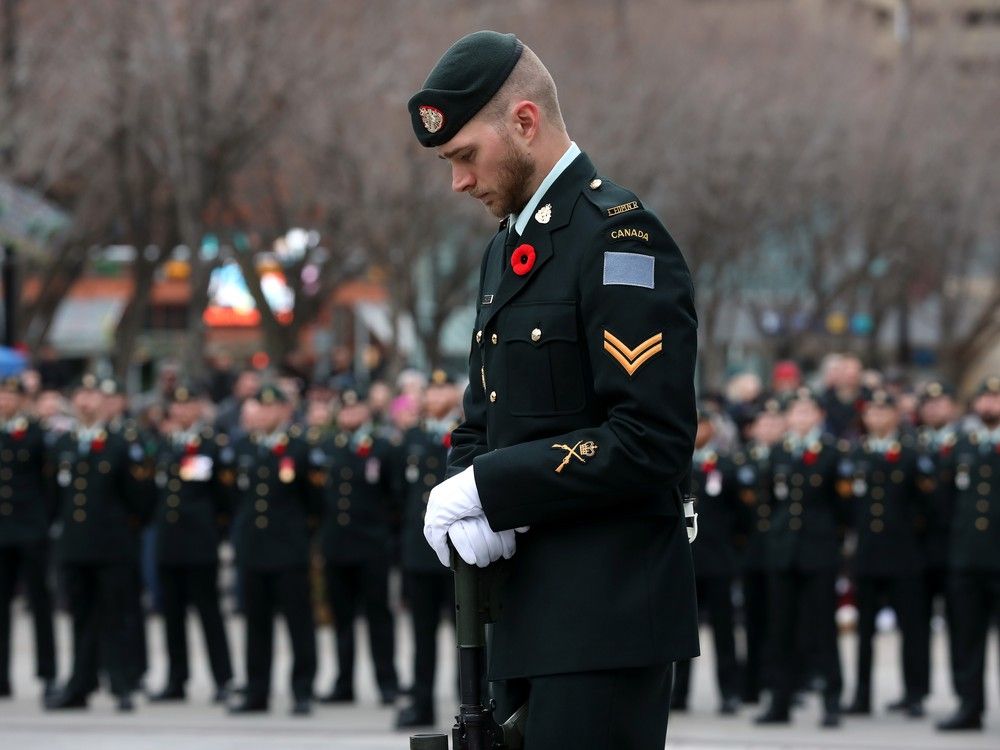
Look closely at them. Standing tall in the biting November breeze, wrapped in those familiar Legion-blue blazers.
Underneath is a crisp white shirt, done all the way up to the collar button, a saluteless gesture to the day’s reverence. Shoes polished until you can see your reflection in the toes. Regimental ties knotted neat and tidy, and those berets tilted just so—the exact way a drill sergeant taught them sixty or seventy years ago, muscle memory refusing to let go.
Recommended Videos
November in Canada doesn’t give you a break. The wind bites right through your coat, spitting sleet and freezing rain against cenotaphs across every small town and city square from coast to coast. But watch the veterans. Their shoulders might carry a slight bend from the years, their knuckles might be stiff from the cold as they pull on thick wool mittens, but nobody is heading for the car. Leaning on their wooden canes, boots planted firmly on the cold pavement, they stand their ground.
I was born into a generation that never had to lace up combat boots or huddle in a trench. I count that blessing every single morning of my life.
My own direct, personal bridge to that world was through my late mother-in-law and father-in-law. Both of them served as sergeants in the Canadian Army. They carried that experience with a quiet, humble grace — no bragging, no complaints, just a quiet sense of duty and love of country. I never smelled gunpowder or listened for air-raid sirens, but every year when the calendar hits Nov. 11, the world around me stops. The noise of everyday life fades out, and my heart fills right up.
Here is something we need to hold close: The danger doesn’t just happen overseas.
Heartbreak can happen right here at home while preparing to serve. More than 2,800 Canadian men and women in uniform have lost their lives on our own soil during training and domestic operations. You think of the young cadets in the 1974 blast at Valcartier. You think of the 1989 Hercules crash out in the brush at CFB Wainwright, the freezing tragedy of Boxtop 22 in the Arctic, the crew of the Stalker 22 Cyclone, and the dark day at Tarnak Farm.
Grief feels the same no matter where the knock on the front door comes from.
We were reminded of that deep ache just weeks ago right here in our own backyard at CFB Wainwright. Out in the scrub during routine maneuvers, an accident cut short the lives of a young soldier and sent comrades to the hospital. No battlefield, no foreign soil — just dusty, hard prairie ground. Wainwright reminds us with a sudden, painful jolt that the sacrifice starts the very first hour someone puts on the uniform.
When the bugle plays the Last Post and that lonely, beautiful horn cuts through the autumn chill, take a look around the crowd.
Look at the veteran with a tear running down a weathered cheek, catching quietly on the edge of that beret. That silence isn’t just a two-minute break in our busy schedules. It’s an embrace. It’s a handshake across generations.
Wainwright sits 200 km southeast down Highway 14, but during this cold autumn stretch, those miles vanish completely. That deep ache traveled right down the prairie highway and landed straight on our doorstep in Edmonton.
We mourn four fallen members of our armed forces and remember the quiet dignity they brought to their service — young men and women who stepped up when asked and traded their future for ours. It is a heavy, quiet kind of pain that stays with you all week long.
When that lonely horn sounds the Last Post, we are not just thinking about history books. We are holding tight to our very own.