
Costs of thefts from the City of Toronto’s bike share program have been racking up, with nearly $400,000 worth of bicycles written off in the last three years.
But while figures obtained via freedom-of-information law suggest it’s a growing issue, the Toronto Parking Authority, which handles the Bike Share Toronto program, disputes the accuracy of those numbers.
Daniel Tate, of the political advocacy group IntegrityTO, requested the documents from the TPA and shared them with the Toronto Sun. Tate said he wanted to know more after he noticed how common a sight stolen Bike Share bicycles had become in his downtown neighbourhood.
“You go for a walk, you go here, you go there, you see so many people who are in throes of addition, and a large proportion of them have bike shares with them that are obviously stolen,” Tate said.
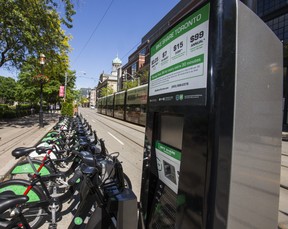
In a written statement, the TPA said Bike Share Toronto has seen lots of growth, with five times the annual ridership from when the program started in 2017. Since then, more than 37 million rides have been taken via Bike Share, and the fleet has grown to more than 11,000 bicycles.
“We continue to actively recover lost bikes, ensuring that we have our fleet available for those who choose to use Bike Share Toronto bikes,” the TPA said.
Internal emails included in the documents show the TPA hasn’t taken the losses lightly.
“For 2024, we’ll be writing off $191.4K in missing bikes. That’s a pretty big number,” Ashleigh Berger, TPA’s senior manager for bike share operations, wrote in January 2025.
“Why is this number so high?”
That message came a year after Arjun Mandyam, a TPA director, sent a chart in a group email that included a $680,000 “value of total loss on missing bikes.”
“There is internal disbelief on the data,” Mandyam wrote.
Tiny share of fleet: TPA
The documents show that in 2023, 267 bikes went missing, or were stolen or “AWOL” – meant to refer to bicycles absent from a dock for 48 hours, by the TPA’s definition. That rose to 346 in 2024 and 434 in just the first 10 months of 2025.
Most of those bikes were of the cheaper Iconic model, the documents show. (The program’s other, pricier model, the E-Fit, is battery powered, unlike the Iconic.)
The number of damaged bikes also appears to be on the rise, from 38 in 2023 to 61 in 2024, plus 48 in the first 10 months of last year.
But in its statement, the TPA said those aren’t the final numbers.
“Over the past three years, 247 bikes have been written off as lost with a depreciated value of $398,000. The value of these writeoffs average 0.61% of the total value of Bike Share Toronto’s annual active fleet and average 0.79% of annual operating costs,” the TPA said.
The statement did not explain the discrepancy in the numbers, nor did it break the missing bikes down by year.
RECOMMENDED VIDEO
A 2025 email from Shift Transit, which manages the day-to-day operations of Bike Share Toronto, hints at some wrinkles in the data.
Lost bikes are supposed to go from “missing” status to “AWOL” after 48 hours – “at least this is what the process is supposed to be,” the email explained, as that switch wasn’t always happening automatically.
Also, bikes don’t always stay lost.
“Historically, we have had bikes come back after being missing for six-plus months or even for more than a year,” the email said.
Tate said he has concerns with the tech being used. On top of the status problem, TPA staff say in emails that there are quality control “issues” and glitches related to putting bikes back in their docks – the step the system needs to see to stop flagging a bike as missing.
The TPA defended its tech.
“We continue to invest in updating our infrastructure, using new technology to upgrade our bikes and stations to deliver a better experience for our customers and support the safety and security of our fleet,” its statement said.
It’s unclear how many stolen bikes are reported to the TPA, and how many to the Toronto Police Service. In a brief statement, the TPS told the Sun it treats reports of stolen Bike Share Toronto vehicles the same as “with any reported criminal offence.”
‘Call this a fail’
Other TPA emails show that Shift Transit had to “retrain” customer service agents after a Good Samaritan was told to take a stolen bike from a homeless encampment.
The customer had complained that it took four days “to even acknowledge that a stolen bike that a customer found is flagged for recovery.”
“I’ve already helped you recover three stolen bikes and I have received no meaningful acknowledgment for it. For example, a free membership extension would be nice,” a customer wrote in October 2024.
The customer was told to “take the bike and return it.” He flagged that message for Shift Transit’s higher-ups.
“Surely it’s not an official policy to encourage folks to retrieve stolen bikes?” he asked.
Justin Hanna, then a director with Bike Share Toronto, was unimpressed.
“I would call this a fail, no?” he wrote to Shift Transit.
Tate speculated there’s an issue with incentives – not just that the TPA’s $1,200 “abandoned bike fee” isn’t working, but also that Bike Share Toronto isn’t rewarding the people who tip them off about missing property.
He also conceded that the program is in an odd spot, looked after by the TPA, which has a strict parking mandate, and is operated by an external group.
“This guy’s doing a great public service, because he cares about the city,” Tate said of the Good Samaritan. “He cares about public property, calling up with a great tip, and they’re still giving him hassles.”
“It’s almost as if they don’t care,” he added.