


P.E.I.’s legislature appears set to pass the first substantial changes to the province’s Coroners Act in nearly 40 years, which will require an automatic review by an expert panel when deaths occur that are linked to domestic violence.
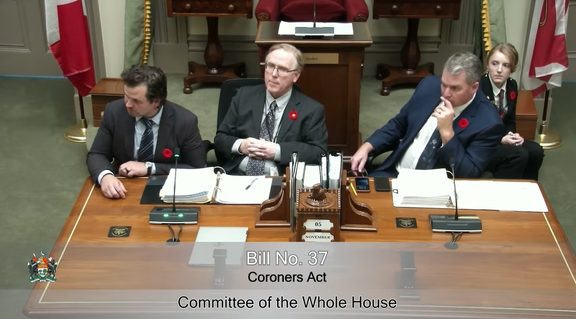
The revamp of the Coroners Act passed second reading in the legislature on Nov. 5. This is typically an indication that a new law will receive royal assent at the conclusion of the fall sitting.
Speaking to The Guardian, Dr. Brandon Webber, P.E.I.’s chief coroner, said the new act would create what are called death review committees. These would be a panel of experts tasked with reviewing either single or multiple deaths.
He said these death reviews would differ from public inquests, which typically involve members of the public making recommendations aimed at the prevention of deaths.
“It can be traumatic to the public to bring in a jury of the public, have them understand complex interactive systems in a matter of a few days,” Webber told The Guardian.
Webber said New Brunswick establishes death review committees to look into cases involving child deaths or workplace fatalities.
P.E.I.’s new Coroners Act would require that a death review be conducted in cases of deaths involving domestic violence.
Webber said this was a recommendation of the Atlantic Domestic Homicide Review Network, formed by the Council of Atlantic Premiers.
These reviews would help establish systemic factors that decision makers could use to make changes to help prevent future harm.
The death review committees could also investigate and monitor trends involving other deaths.
“If we suddenly saw a number of scuba diving deaths on the Island, we could form a scuba diving death review committee,” Webber said, as an example of what this might look like.
Webber told the legislature he hopes to operationalize death review committees within six months.
The current Coroners Act mandates a public inquest following the death of an individual while they are held in custody at a provincial correctional facility or a health facility, provided the death was not preventable nor due to natural causes.
The new act would also allow the P.E.I. coroner’s office to order an inquest at the request of a close family member of a deceased person.
FOIPP Act
Webber said the new act includes provisions that could limit public access to some information about coroner investigations via the freedom of information process.
Cape Breton Eagles to file complaint with QMJHL after on-ice incident against Newfoundland Regiment
 Cape Breton
Promising football player from Halifax dies at U.S. boarding school
 Halifax
RCMP charges man following numerous crimes targeting communities in southwest Nova Scotia
 Annapolis Valley
Bobcat makes unexpected visit to Dartmouth backyard
 Halifax
Fundraiser started to support family of Antigonish County farmer who died in tractor collision
 Nova Scotia
The new act states that, despite the provisions set out in the Freedom of Information and Protection of Privacy Act (FOIPP), a person is not entitled to access records about either an investigation of a death or an inquest that has not yet been completed. Another provision would limit access to records about death reviews that have not yet been completed.
Webber said inquests and death review committee findings will still be a matter of public record.
“It’s just that some information that might lead to harm of an individual (who) participated or provided testimony, we subject that to not be released,” Webber said.
As an example, Webber said a living victim who testified during a death review committee would have their identity protected.
“We would want those people to feel free to testify safely, to try and enact change, but then to protect what they say so that it doesn’t lead them to future harm from a potential perpetrator,” Webber said.
Webber added that, under the FOIPP Act, coroner investigations are not subject to the same protection of privacy provisions as other law enforcement investigations.
In an email, a representative of the Department of Justice and Public Safety confirmed the limitations on freedom of information requests were to allow information and records to be withheld in coroners’ investigations in the same manner as other law enforcement investigations.
“This protection exists because premature disclosure could undermine the effectiveness of the investigation, inquiry, or review,” read an email from Katie Cudmore, communications officer with Justice and Public Safety.
Webber said he attempted to consult on the new bill with the province’s Office of the Information and Privacy Commissioner, but did not receive a response during the consultation period.
In an email, privacy commissioner Denise Doiron confirmed her office sent a response to Webber after The Guardian spoke to him on Nov. 5. This would have been after the bill was debated in the legislature.
“We did not identify any issues with the proposed new legislation from an access or privacy lens,” Doiron wrote in a Nov. 10 email to The Guardian.
Doiron said the current FOIPP Act already allows the Department of Justice and Public Safety to refuse access to records during certain instances “which would include if an investigation or inquest is not yet completed.”
“This is not necessarily substantially different,” Doiron said, referring to the new Coroners Act.
In-custody deaths
There have been instances when details of in-custody deaths in P.E.I. have come to light only after media questions, some of which were prompted by freedom of information requests.
Following the death of an in-custody individual at Queen Elizabeth Hospital in 2018, the CBC sought records about this death, as well as about other inmate deaths over the previous three years, via freedom of information.
The CBC reported in 2019 that the Department of Justice and Public Safety denied access to these records. An inquest was not held in this instance, as the death was determined to be due to natural causes.
Webber conceded the province does not routinely publish records about in-custody deaths or coroner’s reports.
“I’m not sure how to approach that. I’d be interested to explore it,” he said.
Stu Neatby is a political reporter for The Guardian in Prince Edward Island. He can be reached at and followed on X @stu_neatby.


 Pinterest
 Tumblr