
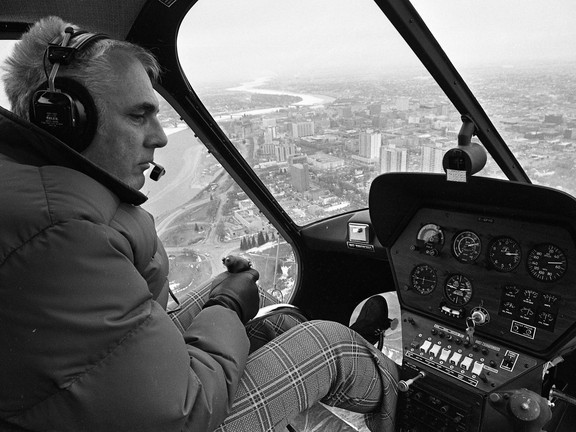
Every Thursday, we feature an image from the StarPhoenix archives, curated by the City of Saskatoon Archives. Today, we see helicopter pilot Bill Abbott flying over Saskatoon’s roads for his reports and predictions on CKOM’s Traffic Watch, from March 19, 1977. (City of Saskatoon Archives StarPhoenix Collection S-SP-A7443-1, photo by Peter Blashill)
From the StarPhoenix archives:
The next time you’re stuck halfway across the University Bridge, take a few moments from contemplating the licence plate in front of you to think about the man in that helicopter 1,000 feet above your head.
If you had listened to him, chances are you wouldn’t be in this mess.
You would know about that stalled car at the top of the bridge . . . you would also know about the broken-down semi-trailer at Idylwyld and 20th Street . . . and the 49-unit freight inching its way across the Diamond.
The man is Bill Abbott of Pultz Aviation Training and he is flying CKOM’s Traffic Watch.
Weekdays from 4:29 to 5:29 p.m., radio listeners can get live reports and predictions on changing traffic patterns during the “rush hour.”
It’s what CKOM programming manager Wally Cameron calls focusing on local services. And as a station promotion, he says reaction from the public indicates “the service is good.”
“This is doing something for people,” Cameron said.
For Abbott, his hour in the air adds up to attempting to distill his observation of five or six key traffic areas into six reports of about half a minute each.
After clearing the ground at about 4:15 and advising the airport tower that Helicopter FYO will be in the air for the next hour, Abbott starts mentally putting together his first report. Initially, the pilot looks for road repairs, construction and trains.
Trains form a big part of the traffic picture in Saskatoon — there are so many places where they cross the roads.
Abbott has acquired an uncanny knack of seeing a train at a distance and predicting when it will hit any given level crossing.
“It’s not too hard to predict the long freights,” he says. “The yard freights are difficult to predict.”
He can estimate the length of a train using a rule-of-thumb formula gained over his 25 years in the air force. He views the train parallel to a strip of runway.
“If I can land an F-86 on it, then it’s 5,000 feet long.”
It isn’t uncommon to find a 7,000-foot freight puffing its way across Idylwyld at 5:30 p.m.
Abbott is at home in just about any type of aircraft, and was a military instructor in both jets and helicopters during various tours of duty across Canada and in Europe.
He is now renewing an association with Saskatoon which was interrupted by his career. Born in Radisson, he attended public school in Saskatoon, Bedford Road Collegiate and the University of Saskatchewan.
Last June, he joined Pultz as a flying instructor, specializing in helicopters.
The busiest day for traffic in Saskatoon is, of course, Thursday, when late night shopping brings out the crowds. Coincidentally, Abbott says Thursday also seems to be the day the big freight trains set up for departure.
During the summer, Friday traffic is heavy.
There are a few constants. Traffic on 25th Street is heavy Monday, Tuesday, Thursday and Friday; University Bridge is always heavy.
As a general rule, traffic moves freely across most of the routes, Abbott says, except when there is an eastbound or westbound freight. In that case, it may be the best to “take the long way home.”
However, he has observed one notable feature of the street system: “It doesn’t take much to block traffic in Saskatoon, partly because of the limited number of lanes.” For instance, if a vehicle is stalled on the University Bridge, the bridge has lost 50 per cent of its capacity, one way. This happened on Wednesday at the top of the bridge. A car was stopped, and traffic was backed up to Cumberland Avenue and onto the campus.
From 1,000 feet, Abbott can pick out any number of things which might tie up traffic — a car with the hood up, a line-up from what could be a stuck traffic signal, even police cars. However, he will not report a radar trap from the air.
Abbott says he has received “excellent co-operation” from the airport tower, which is in regular contact with him while he is over-flying the city, usually to advise of incoming and outgoing aircraft.
Wally Cameron views Traffic Watch as something of an accomplishment, observing that CKOM is the first radio station in Saskatchewan to undertake such a project on a full-time basis.
He admits the spirit of competition is an ulterior motive, because: “Radio is a game of trying to out-fox the other guy.”
Cameron will be closely following reaction to Traffic Watch, and says “if it grows like it started out” the station may consider a morning version. However, he said there is a greater concentration of traffic in the afternoon.
His job as Traffic Watch pilot has been an education for Abbott in assessing Saskatoon drivers. He bases his observation on experience in a number of North American cities, when he says: “More patience is displayed by all motorists . . . Individual motorists have more care for each other.”
Throwback Thursday is a weekly StarPhoenix series where we revisit photos from Saskatoon’s past.
Check out our entire collection here.
What moment in Saskatoon’s history from April would you like us to revisit next? Send suggestions to jbennett@postmedia.com.
The Saskatoon Star Phoenix has created an Afternoon Headlines newsletter that can be delivered daily to your inbox so you are up to date with the most vital news of the day. Click here to subscribe.
With some online platforms blocking access to the journalism upon which you depend, our website is your destination for up-to-the-minute news, so make sure to bookmark thestarphoenix.com and sign up for our newsletters so we can keep you informed. Click here to subscribe.