
One year after presenting a barely-balanced budget, the Saskatchewan government is projecting a deficit approaching $1 billion for 2026-27.
The provincial budget tabled on Wednesday by Finance Minister Jim Reiter forecasts a $819.4-million deficit, against the 2025-26 budget that featured a $12.2-million surplus.
“It’s tough economic times around the world because of geopolitical issues,” Reiter said this week.
“You take the best advice you can from folks in that particular industry, whatever it is.”
Here are five key takeaways from the document.
Saskatchewan is projecting approximately $21.4 billion in revenue — an increase from $21.1 billion one year ago. However, total expenses are also up. The province predicts approximately $22.2 billion in expenses this year compared to $21 billion last year.
According to the province, the gross debt at the end of 2027 is projected to be $43.5 billion. In last year’s budget, the gross debt projection was $38.3 billion.
In the days leading up to the budget’s release, NDP finance critic Trent Wotherspoon said Saskatchewan residents were “bracing themselves for the costs of another mismanaged budget.
“Saskatchewan people deserve a government that manages their money responsibly and keeps life affordable,” Wotherspoon said.
On budget day last year, Reiter acknowledged looming concerns over U.S. and Chinese tariffs, calling it “a time of incredible uncertainty.” At the time, Reiter said he considered a contingency fund but ultimately elected against it.
This year, Moe noted in advance of budget day that there would be a deficit, largely due to market and continued trade uncertainty. He acknowledged that China’s previous tariffs on Canadian canola products negatively affected revenues.
2. Health care a major focus
Funding for health care remains the single biggest number in the document.
The 2026-27 budget features $8.47 billion for the Ministry of Health, an increase of around $400 million, or five per cent, over last year.
Of that $8.47 billion, the Saskatchewan Health Authority is set to receive $5.15 billion.
Earlier this month, the government rolled out what it has dubbed the Patients First Health Care Plan, which aims to increase the number of nurse practitioners, lower wait times, expand virtual appointments and connect residents to a primary care provider. The plan also looks to widen the mandate of the Saskatchewan Healthcare Recruitment Agency to improve training, recruitment and retention.
“This budget delivers on the priorities outlined in our Patients First Health Care Plan to ensure everyone can receive the right care in the right place at the right time,” Health Minister Jeremy Cockrill said in a news release.
3. Province touts affordability measures
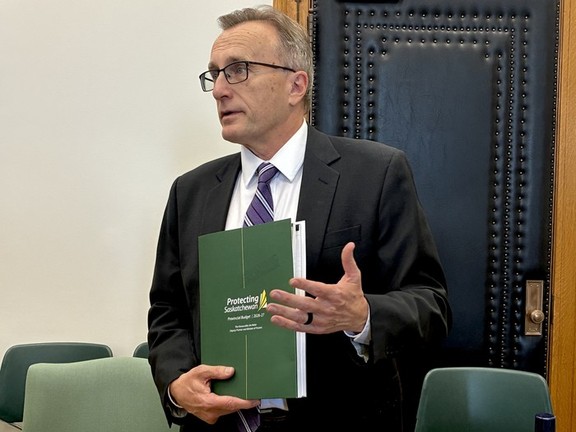
This year’s budget is titled Protecting Saskatchewan, a term Reiter used multiple times during a pre-budget scrum. It’s printed boldly on the front page of the province’s budget document.
The finance minister said the government campaigned on affordability and insisted the Saskatchewan Party was “continuing to implement our campaign promises.”
The budget notes around $2.5 billion in annual affordability measures, including an increase to personal, spousal, equivalent-to-spouse, and child tax exemptions; seniors’ supplement; and the Saskatchewan Low-income Tax Credit.
Reiter acknowledged the widespread challenges that come from issues like rising and falling oil prices, tariffs, international relationships and more.
“There is no doubt we faced challenges creating this budget, but it is a budget that delivers on commitments our government has made to the people of Saskatchewan to deliver significant affordability relief while continuing to protect our strong and growing economy,” Reiter said on Wednesday.
4. Less increase for education
A long labour dispute between the Saskatchewan Teachers’ Federation (STF) and provincial government was still fresh on peoples’ minds when budget time rolled around last year.
The 2025-26 Saskatchewan budget allocated $4.43 billion for education. Funding is still up year over year in 2026-27, though not as drastically, with approximately $4.6 billion going toward education.
Of that $4.6 billion, $3.6 billion is for the Ministry of Education itself, which is an increase over last year’s $3.5 billion.
Of note one year ago, the province earmarked $130 million to fund the new collective agreement with teachers and address enrollment and classroom challenges.
This year, the government says the province’s 27 school divisions will get a total of $2.5 billion for 2026-27, up 2.6 per cent from $2.4 billion in operating funding in 2025-26.
The school divisions received an 8.4 per cent increase last year.
5. Funding record for municipalities
The province this year will be distributing nearly $400 million to municipalities.
Increasing the allocation by approximately $30.7 million, or eight per cent, the budget has earmarked $392.4 million in municipal revenue sharing. It is the highest-ever amount since the program was implemented in 2008.
“We are investing wisely, providing funding to municipalities to assist in meeting the priorities that matter most to their residents,” Government Relations Minister Eric Schmalz said.
Under the program, the province shares revenue with the municipal sector, with the money linked to Saskatchewan’s economic performance. The provincial government says the program offers predictable, no-strings-attached funding based on three-quarters of one point of provincial sales tax revenue from two years prior.
The Saskatoon Star Phoenix has created an Afternoon Headlines newsletter that can be delivered daily to your inbox so you are up to date with the most vital news of the day. Click here to subscribe.
With some online platforms blocking access to the journalism upon which you depend, our website is your destination for up-to-the-minute news, so make sure to bookmark thestarphoenix.com and sign up for our newsletters so we can keep you informed. Click here to subscribe.