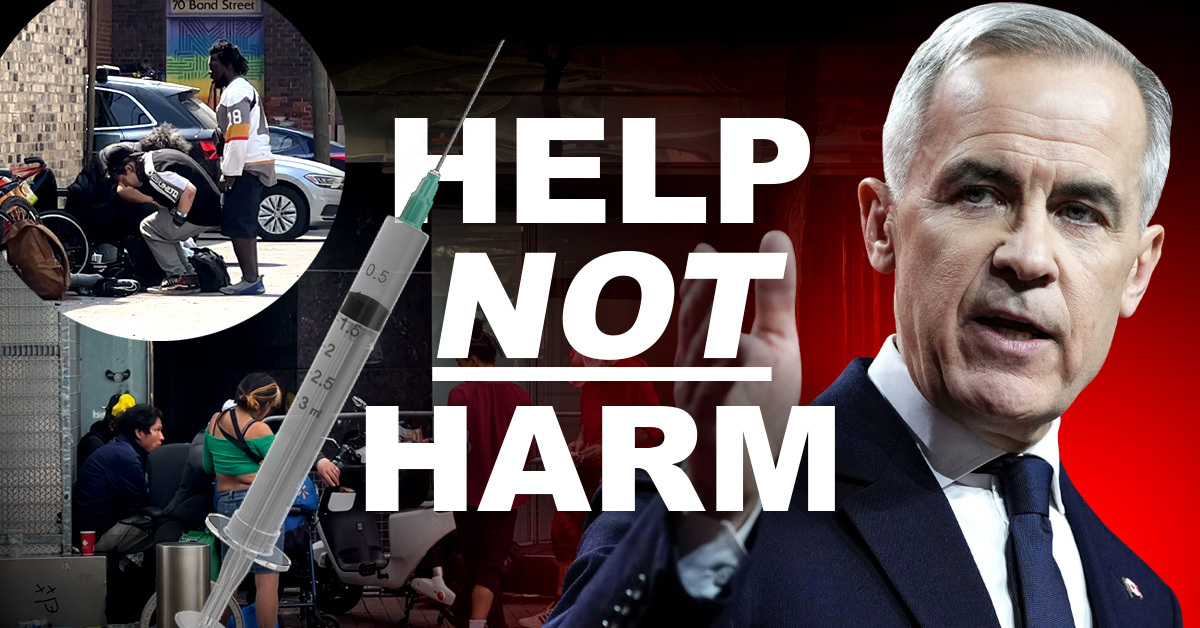

While people rot in addiction on the streets of Vancouver and families bury their children, an entire industry has grown up around Canada’s drug crisis.
Taxpayer-funded programs handing out opioids. Vending machines dispensing drugs — and now we’re learning that some of the very people who pushed these policies may have built businesses around them.
If that’s true, this is evil profiteering off human misery. And the people paying the price are the addicts themselves.
While politicians and public health bureaucrats debate ideology in conference rooms, the reality on the streets is brutal: people are dying; people are languishing in absolute misery. Families are watching their loved ones slowly disappear into addiction.
And in British Columbia, the death toll just keeps climbing.
In January alone, 150 people died from toxic drugs in B.C — that’s nearly five people every single day. Five people who didn’t get recovery. Five people who didn’t get their lives back. Five people whose addictions were managed instead of ended. Five families grieving.
Yet instead of asking whether their policies are failing, the political and public health establishment in B.C. keeps doubling down.
More “safe supply.” More decriminalization. More taxpayer funding for programs that distribute drugs. And now, even machines that dispense opioids.
But now another disturbing layer to this story is emerging.
Conservative MP Dan Mazier recently highlighted testimony at a parliamentary health committee that should make every Canadian stop and ask some very uncomfortable questions.
According to that testimony, some of the same public health figures who helped shape B.C.'s drug policies later launched companies tied directly to those same policies.
Addiction physician Mark Tyndall helped launch MySafe Society, the group behind opioid vending machines. Those machines dispense prescription opioids to registered users.
Another prominent figure in B.C.’s drug policy world, Perry Kendall, helped found Fair Price Pharma — a company created to produce a domestic supply of injectable heroin.
Now think about that for a moment: people involved in shaping public drug policy… helping expand the concept of government-supplied drugs… then moving into companies built around distributing those drugs.
If that doesn’t raise conflict-of-interest concerns, it absolutely should. The consequences of these policies are not theoretical. They are playing out in real time on the streets of Vancouver.
That’s the philosophical core of the harm-reduction model that dominates British Columbia. Addiction isn’t something to end. It’s something to manage indefinitely.
An entire ecosystem of programs, organizations, and bureaucracies built around addiction itself. A system that risks becoming permanent.
Because if addiction can never truly be solved, there will always be justification for more programs, more funding, and more infrastructure around it.
But just one province over, Alberta has taken a different path.
Instead of building infrastructure to distribute drugs, Alberta has focused on something that has become almost controversial in modern addiction policy: recovery.
The province has expanded treatment capacity and built what it calls a recovery-oriented system of care — one that focuses on getting people off drugs entirely.
Alberta has also closed or restructured supervised consumption sites that were causing serious problems in surrounding communities.
One of the most famous examples was the ARCHES injection site in Lethbridge. At one point, it was the busiest supervised consumption site in North America.
When the Alberta government shut it down, activists predicted disaster — but the catastrophe never came. More people began accessing treatment, and Lethbridge began moving away from being a magnet for open drug consumption.
Alberta’s approach is showing something different, that compassion can also mean helping people recover. And the most compassionate thing society can do is not build systems that normalize addiction forever.
We must build systems that help people leave it behind.
If the testimony raised in Ottawa proves accurate, British Columbia’s system may have crossed an even more troubling line.