
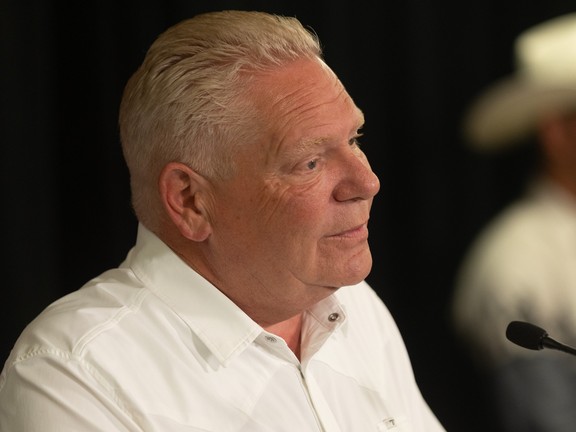
As his government battles close to 200 forest fires in Northern Ontario, Doug Ford got a little heated himself on Friday.
Speaking from a news conference at a Toronto emergency response centre, in front of a screen that glowed orange with a map showing the ongoing fires, the premier said American politicians who have complained about Canadian “inaction” to the blazes should remember that Ontario has often sent resources to help deal with natural disasters south of the border.
“If there’s some politician out there chirping away, maybe what you should do instead of complaining is send help, because we have done the exact same thing for our American friends,” Ford said.
He noted that Ontario had water bombers standing by to go to California during that state’s wildfires last year, but didn’t send them because there was no water supply available for them. The province also sent crews to help with hurricane-related repairs in the southern U.S. last year, he said.
Hours after the premier spoke, Donald Trump posted on social media that Canada was guilty of “wilful negligence” in allowing “filthy air” into the United States.
The U.S. president said he would call Mark Carney about it and threatened to add pollution costs to Canada’s tariff bill.
It is unclear what costs the U.S. government had incurred as a result of wildfire smoke.
Four Republican members of Congress signed a letter to Carney earlier this week that said their constituents “are breathing the consequences of (Canadian) failure right now.” The message seemed to suggest that U.S. officials would take fire-prevention action of their own on Canadian soil in the future. “With sovereignty comes responsibility,” the letter said, in a none-too-subtle wink to U.S. President Donald Trump’s repeated musings about Canada becoming the 51st state.
Speaking to ABC News after his Toronto news conference, Ford called suggestions of firefighting inaction “the most insulting thing I’ve ever heard” and said that his province is twice the size of Texas. That state is currently battling catastrophic flooding after heavy rains.
“It’s unfortunate they want to politicize this,” Ford said to ABC of the Michigan members of Congress.
At his Toronto news conference, the premier also saved some indignation for opposition MPPs who have accused his government of underfunding fire response teams.
“What I find despicable and disgusting is that opposition (members) would politicize the amount of money being spent and go out there and put false information out,” the premier said.
NDP and Liberal MPPs have said the Ford government’s base budgeting numbers for emergency forest firefighting are too low, given that it routinely exceeds them, but the premier said the only number that matters is what is eventually spent. He said there is no limit on what the province will spend to get the fires under control.
Last year, the $135 million budgeted for forest fire response was by the end of the year more than doubled, to $271 million, he said.
“In times of crisis, all levels of government, including the opposition, need to come together,” Ford said. The criticism, he said, was “absolutely disgusting.”
Members of the union that represents workers in forest fire response have also said spending in those areas has not kept up with the increasingly severe nature of Ontario’s wildfire season.
There have been complaints from some northern communities that the provincial response was not fast enough to deal with rapidly changing conditions, and a number of those same communities evacuated before an official order to do so was given.
But Mike Harris, minister of natural resources, said the scale of the fires meant provincial authorities could not be everywhere at once.
In Collins, north of Thunder Bay, for example, Harris said a large fire broke out close to the community, and it was on top of them before a provincial response could be coordinated. Residents of that community have since been taken to Thunder Bay, he said, one of several towns in the province hosting those displaced by the fires, from Sioux Lookout to Niagara Falls to Toronto.
The premier said fire crews are battling 191 separate fires in the province’s vast north, with 10 communities either evacuated or under evacuation, and another four on standby pending the status of nearby fires.
The fire season last year saw about 600,000 hectares burned, Ford said, while this year the total is already up to 650,000 hectares.
Jill Dunlop, minister of emergency preparedness and response, said more than 150 crews are dealing with forest fires in the north and more than 80 firefighting aircraft are working in the region.
Dunlop said First Nations leaders in the north can contact the Provincial Emergency Operations Centre, which will coordinate any potential response with the federal government, local leaders and the Canadian Armed Forces. She said a local declaration of emergency is not required to access provincial support.