
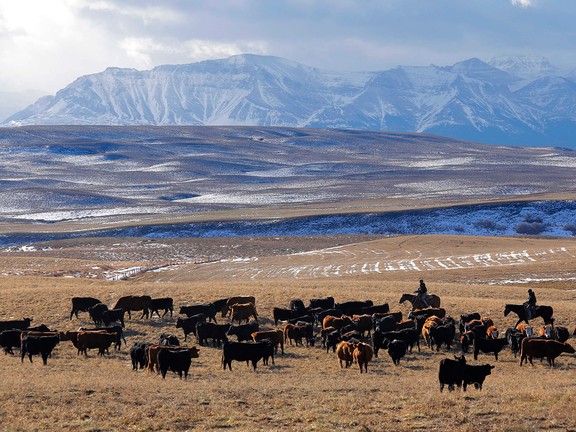
OTTAWA — The federal environment minister has indicated it’s possible that private, working Alberta ranches could be counted as part of meeting the government’s land-conservation targets, suggesting potential to break the impasse between Ottawa and the province over the federal strategy.
Alberta and Ottawa have been divided over Prime Minister Mark Carney’s announced plan in late March to protect at least 1.6-million square kilometres of new lands over the next four years. The target is part of a United Nations-led push to designate 30 per cent of Earth’s land and marine area as protected areas by 2030, a goal known as 30 by 30.
During a meeting of the country’s environment ministers in Calgary this week, Alberta Environment Minister Grant Hunter said that the new federal conservation target was already sparking concerns about government meddling from ranchers in the province, and the “narrow scope” doesn’t take into account the work ranchers are already doing to preserve their lands.
“I certainly know lots of ranchers, friends of mine, that are saying, ‘You know what? We know the biodiversity on our ranch (and) these are working landscapes,'” said Hunter.
At a press conference after the meeting, Julie Dabrusin, the federal environment minister, said she was able to visit a working landscape ranch while in Alberta, and was impressed by what she saw. She said that ranches like the one she toured could potentially count under the plan under the category of other effective area-based conservation measures (OECMs).
The OECM category allows land that isn’t necessarily protected but is managed to preserve biodiversity to count toward the 30 per cent target.
“Our nature implementation plan earlier this year included several parts … (and) one part that was important is on land. Like, how do we preserve, conserve the lands and waters that Canadians love so much, and that includes in it other effective conservation measures,” she said. “What it really is is about how do we better recognize working lands that are also conserving land.”
“And actually, the rancher example is another great example that can be used. I had the opportunity to … actually get to see, in real life, in the most beautiful way, the care and protection of the lands (and) the knowledge of the grasses,” said Dabrusin. “I think this is exactly the kind of space where we can work together with provinces and territories in recognizing the good stewardship of so many Canadians who care for their land.”
A senior Alberta government official speaking on background said that, under the province’s own criteria, nearly 60 per cent of the province’s land is already protected. However, the amount of protected area drops to 20 per cent using strict international biodiversity standards applied by the federal government.
The official confirmed that the province and Dabrusin have had a “number of bilateral discussions” that seem to be making progress on a compromise, although the federal government has been “less than clear” about what landscapes they’ll accept as protected lands.
A senior federal government official familiar with the matter didn’t comment directly on Hunter’s concerns, but said it would be inaccurate to say that Ottawa will be “imposing” federal reporting standards on the province.
The Carney government’s land-use initiative has also been criticized by Alberta Premier Danielle Smith.
Smith said on her radio show in April that she’s wary of land-management practices in federally protected areas after devastating wildfires in recent years in Jasper National Park and Waterton Lakes National Park, which are both federally run parks in Alberta.
“Well, I can tell you, we don’t think that the only way to manage landscapes is to build a fence around it, allow it to grow so old that all the vegetation becomes thick and dense and a fire hazard, and then wait for it to burn down,” said Smith.
Smith has said that she won’t sign off on the creation of “one additional acre” of federal parkland in Alberta.
National Post
rmohamed@postmedia.com
Our website is the place for the latest breaking news, exclusive scoops, longreads and provocative commentary. Please bookmark nationalpost.com and sign up for our daily newsletter, Posted, here.