
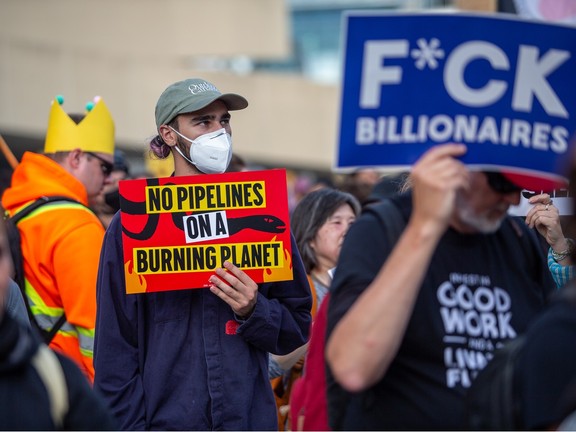
For a movement supposedly wandering the political wilderness, the Canadian left made a lot of noise in downtown Toronto Monday night.
Hundreds of protesters gathered at Nathan Phillips Square before marching to the Art Gallery of Ontario, where Prime Minister Mark Carney was hosting some of the world’s wealthiest investors. The demonstration reunited an old-school coalition of labour unions, Indigenous activists, environmentalists, housing advocates and anti-war groups under a new(ish) slogan: “The Many vs. The Money.” Memories of Occupy Wall Street and “We are the 99 per cent” wafted through the air, though thankfully no one sought to pitch tents outside city hall — yet.
Recommended Videos
Welcome back, class warfare. Only 18 months ago, the Canadian left looked decidedly passé. The 2025 federal election devastated the NDP, reducing it to six seats and costing leader Jagmeet Singh his own. Voters worried about U.S. President Donald Trump and economic instability flocked to Carney and his promise of sober, competent government.
Then this past March, Avi Lewis won the NDP leadership with 56 per cent of the first-ballot vote. Lewis’ platform took a sharp left turn, pledging wealth taxes, public grocery stores, and fossil fuel moratoria. Underlining it all was a slogan that sounded all too familiar this weekend: “for the many, not the money.”
Now, Carney may have given the NDP a boost — or at least, a foil. His Canada Investment Summit brought leading global investors and Canadian CEOs to Toronto to pitch more than 160 projects in energy, mining, technology and infrastructure. He’s also talking about privatizing airports and announced the Productivity Mega Deduction, a set of tax incentives that will cut Canada’s marginal effective tax rate on new business investment from 13 per cent to 6.4 per cent, less than half the U.S. rate and the lowest among major economies.
That’s music to Lewis’ ears. It bolsters his accusations that Carney, the former banker and Brookfield chair, is putting corporations ahead of Canadians struggling with affordability — and boosts Lewis’ call to “redeploy” the country’s wealth “to directly address the daily emergency that Canadians are going through.”
But from whom will Lewis pull voters? Common wisdom would say the Liberals, but they are sitting pretty at 46 per cent, unchanged from when Lewis took office. Meanwhile, the NDP is up three points to 11 per cent, while the Conservatives are down by the same number, at thirty-three.
Could this small shift represent a defection of the labour support that Conservative leader Pierre Poilievre courted during the last election? Hard to say, because Lewis’ policies would also shut down union jobs in the oil and gas sector and were slammed in the West. But someone in Tory-land may be paying attention: in March, the party quietly removed support for right to work legislation, generally considered seen as an anti-union position, from its constitution.
And the conditions that nurtured Poilievre’s right-wing populism can do the same for the left. Housing remains painfully expensive. Young Canadians say the economic system is stacked against them. Corporate concentration in businesses like groceries, banking and telecommunications provides ready-made villains. And a government that offers incentives to multinational investors creates precisely the perception Lewis needs: there is plenty of money, just not for you.
There are signs Lewis’ message is finding an audience. In last month’s Beaches–East York byelection, the NDP’s Shannon Devine more than tripled her share of the vote to 26 per cent from seven per cent in 2025. She still lost badly to the Liberals, who won with 56 per cent, but in 2025 they had 68 per cent. The Conservatives, meanwhile, got trounced, dropping from 24 to 16 per cent.
The larger question is whether Lewis can channel protest anger into electoral results. Factors include the economy’s performance, the other parties’ fortunes, and possibly how Democratic socialist candidates do in the U.S. midterms. The battle for the working-class voter has just begun.
Tasha Kheiriddin is Postmedia’s national politics columnist.