
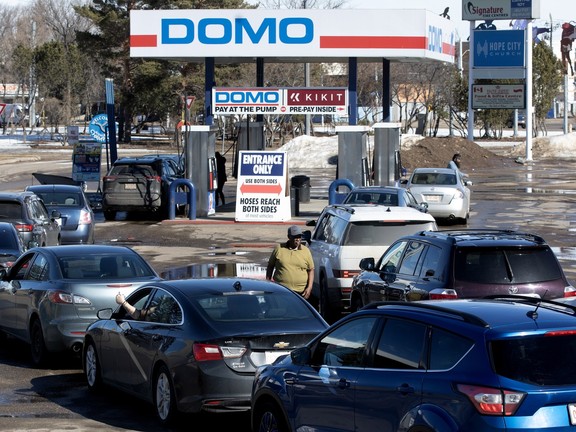
Global oil prices have spiked since Israel and the United States began strikes on Iran more than two weeks ago, disrupting a key corridor for oil shipments, the Strait of Hormuz, which carries around one-fifth of the world’s oil.
Edmonton economist and MacEwan University professor Subhadip Ghosh says while high oil prices have been historically good news for Canadians, the recent highs are hitting the country differently than in previous decades.
The following interview has been edited for brevity and clarity.
Q: How will the rising price of oil affect the cost of living?
A: Oil is used in transport and in the production of everything. As oil prices rise gradually, other things will also go up. The Bank of Canada estimated that, in Canada, a $1.10 increase in oil prices adds roughly 0.3 percentage points to inflation over the following year. Let’s say you have to transport wheat from somewhere. The transport prices go up with the gas prices. The stores have to pay more for the gas just to keep the store heated. We will feel the pinch immediately at the gas pumps, but over time those things will start going up as well.
Q: The price spiked really high, went down, and then has been trending upwards. Why is it such a roller coaster?
A: The price depends on the global market as well, not only here. Part of it is due to the disruptions, but part of it is due to how the global market is reacting to the risks. When the market is feeling the disruption is going to end soon, then the prices will be going down. When they think it’s going to last a while, if they’re getting that message, then it will again change.
Q: What else can affect the price of gas we pay at the pump?
A: Crude oil is probably 50 or 60 per cent of the gas price. But there’s also refining, then transportation costs back to the gas pumps. There are taxes too and competition between the stations. These explain why the prices differ between the cities. In Alberta, our prices are slightly lower, partly because the taxes are lower here compared to the rest of Canada, and also we are close to the refining so the transportation costs are lower.
Q: Who is impacted the most by this?
A: Since Alberta is a major oil producer, high oil prices will also bring in more revenue for the energy companies and also royalties for the provincial government. So it’s not all bad news. Part of our economy will gain, but still there will be winners and losers. Regular households who are not connected to that or do not have shares with oil companies, they are going to lose. They have to pay more, both with the gas prices and through second order effects on other prices
Q: How do these oil shocks compare to spikes we saw in previous decades?
A: If you look at it in the 2000s, let’s say the middle of 2000 or the 2010s, I would say the Canadian dollar acted very much like a petrodollar. When oil prices went up, the Canadian dollar also went up. That creates what in economics we call a terms of trade effect. Which means that since Canada is a net exporter of oil, it receives more for its exports relative to what it’s paying for the import.
But what happened recently, and the Bank of Canada noted this too, is that cushion weakened. From around the mid-2000s the Canadian dollar is no longer closely tied to the gas prices. Part of the reason is the Canadian oil and gas extraction fell quite a bit.
Therefore, some of the foreign investment that used to follow was extracted. Secondly, energy companies already built quite a bit of infrastructure in places like Fort McMurray.
So right now when they are getting more money with oil prices, they’re returning the profits to the shareholders through dividends and buybacks.
Bookmark our website and support our journalism:Don’t miss the news you need to know — add EdmontonJournal.com and EdmontonSun.com to your bookmarks and
You can also support our journalism by becoming a digital subscriber. Subscribers gain unlimited access to The Edmonton Journal, Edmonton Sun, National Post and 13 other Canadian news sites. Support us by subscribing today: The Edmonton Journal | The Edmonton Sun.