

Bob Pulford was a tenacious penalty-killer and a relentless forechecker whose pesky forays drove hockey rivals mad. Gordie Howe called him “one of my private headaches.”
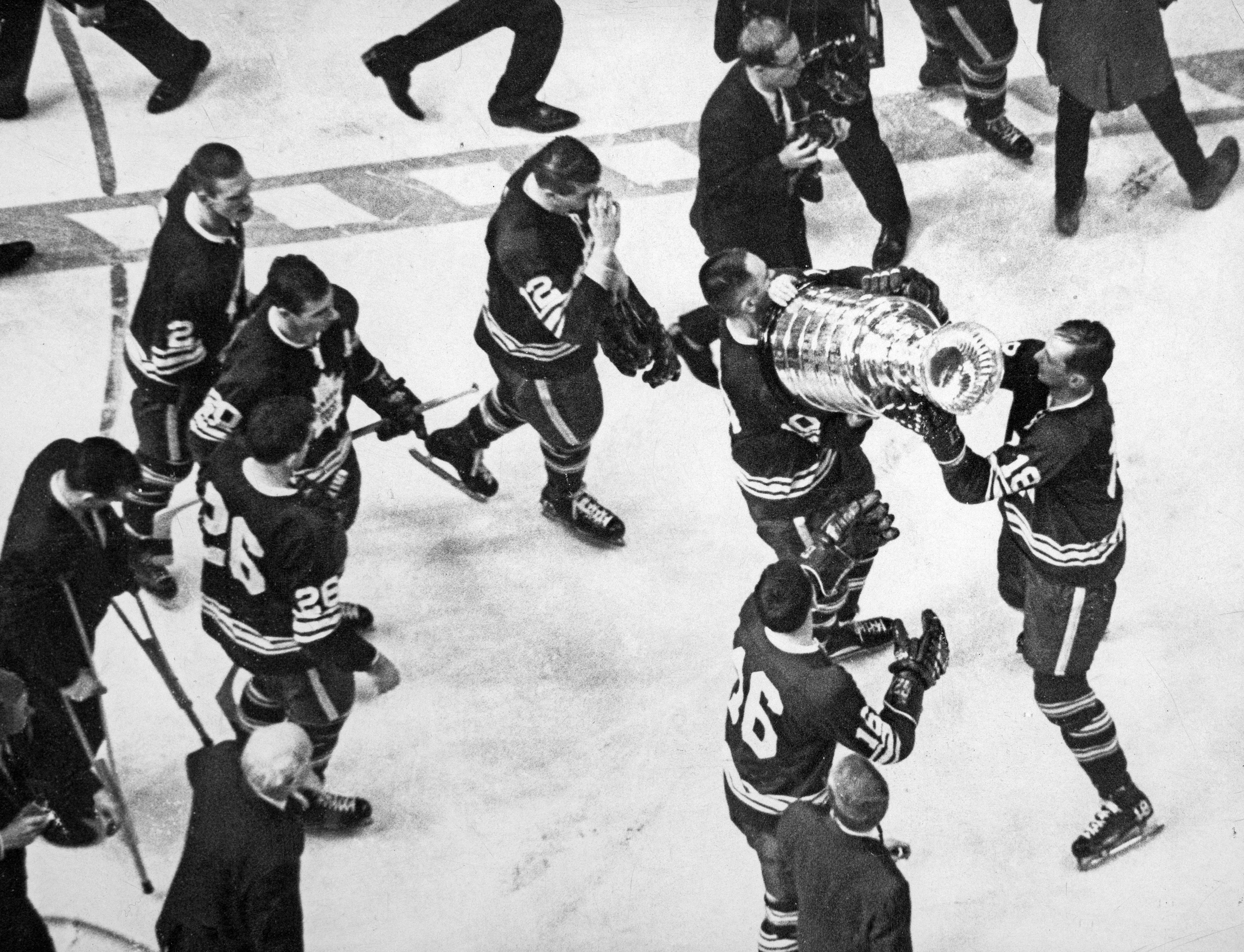
Mr. Pulford, who has died at 89, was a hard-working, two-way player for the Toronto Maple Leafs dynasty of the 1960s, winning four Stanley Cups with the club. An opposing coach once called him “the backbone of the Maple Leafs.”
His sharp shooting and sensible positional play were especially effective in the playoffs, as he scored several notable goals. In 1964, he scored an unassisted shorthanded goal only with two seconds left in regulation time to give Toronto a 3-2 victory over Detroit in the opening game of the finals. The Leafs went on to win the Cup in seven games. Three years later, he won Game 3 of the finals with a goal in the second overtime period. Toronto went on to win the Cup in six games against the defending champion Montreal Canadiens.
A student of the game described on his induction to the Hockey Hall of Fame as “a hockey player’s hockey player,” Mr. Pulford had a long career as a coach, general manager and executive with the Los Angeles Kings and the Chicago Blackhawks. He also coached Team USA at the 1976 Canada Cup.
While he never won an individual trophy as a player, Mr. Pulford won the Jack Adams Award as the National Hockey League’s coach of the year with the Kings in 1975. He won the Lester Patrick Trophy in 2011 for his contributions to hockey in the United States.
An unassuming presence on and off the ice, he had a reticence that led some reporters to nickname him “Mute Rockne,” while it was said he was so dour that bartenders asked him to leave their establishment at the start of happy hour.
“I’m just not a good interview,” Mr. Pulford once said, admitting to shyness. “I don’t say funny things. Sometimes I don’t say anything.”
As a player, he sometimes flushed about the neck, face and ears. Globe and Mail sports columnist Dick Beddoes dubbed him Pully, the Redneck Centre.
“How come you go so red? Temper?” Mr. Beddoes once asked.
“No,” Pulford replied. “Exertion.”
Robert Jesse Pulford was born on March 31, 1936, in the Ontario hamlet of Newton Robinson. He was the youngest of three sons born to the former Lillian Evalene Copeland and Joseph Henry Pulford, a farmer.
Before the boy started school, the family moved to Weston, which was then a suburb northwest of Toronto. He played hockey and lacrosse for local teams, while also suiting up for the Weston Collegiate football team.
As a left-winger with the Toronto Marlboros under coach Turk Broda, a former Maple Leafs goalie, Mr. Pulford won back-to-back Memorial Cups as junior champions in 1955 and 1956, defeating the Regina Pats both seasons. In 11 playoff games in 1956, he scored 16 goals with eight assists, including hat-tricks in each of the final two games.
He graduated to the Maple Leafs the following season. In his first game, coach Howie Meeker assigned him to shadow the great Maurice (Rocket) Richard of the Canadiens. It took eight games before he scored his first NHL goal, against Al Rollins of Chicago in a 4-1 Leafs victory in Toronto, and another 15 games before he scored his second. He would end up with 11 on the season.

The Leafs ended an 11-year championship drought by defeating the defending champion Blackhawks to win the Stanley Cup in 1962. Mr. Pulford, playing on a line with Bert Olmstead and Bob Nevin, scored a hat-trick in the penultimate game. He did so despite suffering torn ligaments in his right shoulder, which needed to be frozen before each game.
The Leafs repeated as champions by defeating Detroit in five games in 1963 with the forward earning seven points in 10 playoff games.
In the opening game of 1964 final, the Leafs were tied 2-2 with Detroit when Allan Stanley was called for holding with less than a minute to play in regulation time. Down a man, Leafs coach George (Punch) Imlach had Mr. Pulford on the ice for a face-off in Toronto’s end. The puck was passed to the point.
“The puck somehow came to [Detroit’s Norm] Ullman, but he never had control of it,” Mr. Pulford said after the game. “I poked at it and I think it hit my shoulder and bounced out over the blue line. Then I was gone.”
With Mr. Howe chasing after him and the clock ticking down, the Leafs forward raced after a loose puck, corralling it at centre. The left-handed shooter moved the puck to his backhand to keep it from his pursuer. “He had a stride on me,” Mr. Howe said, “but I might have caught him if he hadn’t switched to the backhand. When he did that, I was done.” With a sweep of his stick, Mr. Pulford fired a hard, backhanded shot over the right shoulder of a crouching Terry Sawchuk, catching the far corner of the net just under the crossbar. The Leafs averted disaster as Mr. Pulford delivered a winning goal with just two seconds on the clock.
“It’s luck when you pull it out like that,” Mr. Pulford said. “I hardly believe it myself.”
In an informal poll conducted by Jim Vipond of The Globe and Mail, hockey writers selected Mr. Pulford over Mr. Howe as the most valuable player in the playoffs. The NHL introduced the Conn Smythe Trophy for that honour in the following season.
In Game 3 of the 1967 Stanley Cup final, Mr. Pulford’s winning goal in double overtime gave the Leafs a 3-2 victory and a 2-1 series lead. Montreal’s rookie goalie Rogatien (Rogie) Vachon had stymied the Leafs for nearly 50 minutes before Mr. Pulford, having eluded defenceman Terry Harper with a clever spin at the side of the Montreal goal, took a pass from the corner and shoveled the puck into the net.
In the final minute of Game 6 of the same series, Mr. Pulford fed a backhanded pass to George Armstrong, who fired an insurance goal into an empty net as Toronto won 3-1 to claim the Stanley Cup. They have not won another in the subsequent 58 seasons.
In 1970, Mr. Pulford was traded to the Los Angeles Kings. In his second season with the club, after which he retired as a player, Mr. Pulford served as team captain.
In 1,079 regular-season games, the forward scored 281 goals with 362 assists. He added 25 goals and 26 assists in 89 playoff games.
He had been an assistant captain with the Maple Leafs only to have management strip him of the role after he became the inaugural president of the fledgling NHL Players’ Association in 1967. He got that post through his friendship with player agent Alan Eagleson, a lawyer and a former teammate in lacrosse who many years later pleaded guilty to fraud charges in both Canada and the United States.

Mr. Pulford was a rare hockey player of his era to earn a university degree. After years of studying at night and during the summer, he graduated with an economics and history degree from McMaster University in Hamilton. Without hockey, “I probably would have been a lawyer,” he once said.
Just months after retiring as a player, Mr. Pulford became head coach of the Kings. In his third season, he guided the team to a record of 42 wins, 17 losses, 21 ties for 105 points, winning coach-of-the-year honours.
In 1977, he was hired as coach and general manager of the Blackhawks. With hair prematurely turned white, he was a familiar figure behind the bench. He relinquished coaching duties only to take them up again several times, as he did in his role as general manager, which he last held in 2005. As a front-office executive, he worked on marketing and other club business interests.
As well as his induction into the Hockey Hall of Fame in 1991, he was named to the Etobicoke Sports Hall of Fame in 1998. Mr. Pulford was listed at No. 26 of the greatest 100 Maple Leafs as named by the club on its centenary in 2016.

Mr. Pulford died on Jan. 5 at his home in Florida. He leaves his wife of 62 years, Roslyn Ruth (née McIlroy), as well as their children, Rob Pulford, Lindsay Barrett, Jennifer MacRitchie, and WandaMae Lombardi, who is married to prominent hockey executive Dean Lombardi. He also leaves eight grandchildren. He was predeceased by brothers William Joseph (Bill) Pulford, who died in 2002, and Clarke Kenneth Pulford, who died in 2019.
Mr. Pulford’s death leaves Dave Keon, 85, and Frank Mahovlich, 88, as the last survivors of the 11 players to have won four Stanley Cups with the Maple Leafs in the 1960s. Mr. Mahovlich, who served in the Canadian Senate, also won two more Stanley Cups with the Canadiens.
Special to The Globe and Mail
You can find more obituaries from The Globe and Mail here.
To submit a memory about someone we have recently profiled on the Obituaries page, e-mail us at obit@globeandmail.com.