Posted September 15, 2026 3:37 pm.
Last Updated September 15, 2026 4:26 pm.
On Day 20 of the Quebec election campaign, MNA candidates debated public health and the role that prevention should play in public policy to achieve lasting improvements in the population’s health even as questions swirled around the latest IT project scandal surrounding the Coalition Avenire Québec (CAQ) government.
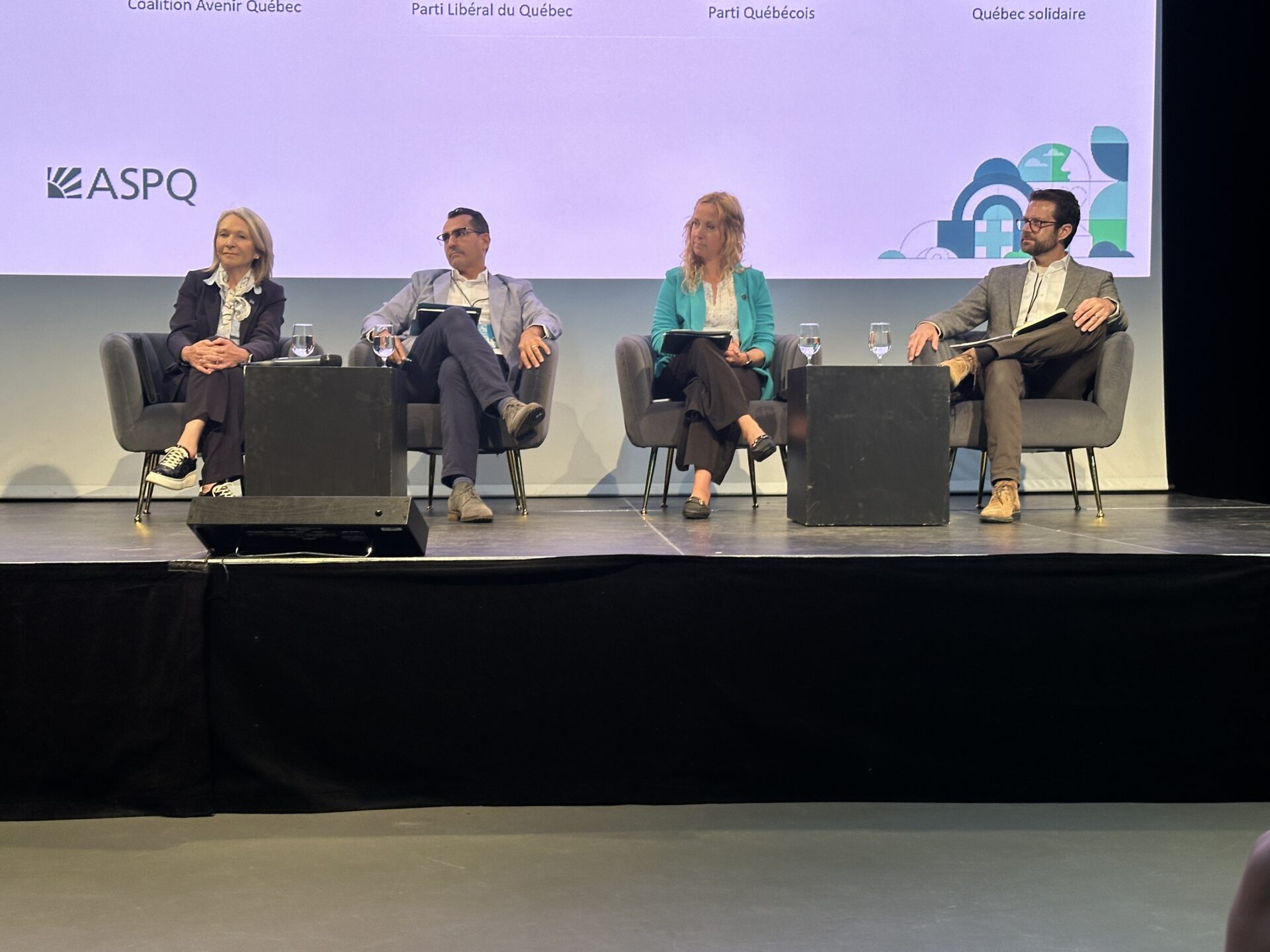
At the “New Vision for Health” summit, held Tuesday at the Université du Québec à Montréal (UQAM), candidates discussed several health-care topics including the fight against homelessness, financing for prevention and the implementation of innovations.
Various stakeholders from the healthcare sector, academia, researchers, and politicians emphasized the importance of investing more in prevention during the event organized in collaboration with the Quebec public health association (ASPQ).
Fabrice Brunet, vice-rector of UQAM’s health sciences department said, the debate showed a shift away from how political parties talked about health care in the past.
“The four parties which were here today, the four advocated for public health and health promotion, which is good because three or four years ago it was not the case,” Brunet said. “We were much more disease-focused and not health-focused.”
Former Quebec Premier and UQAM Chancellor Pauline Marois delivered an opening address that was warmly applauded by the audience of experts in attendance. “We’re talking about prevention. In fact, the word seems simple. Everyone is in favor of it, I’m sure. But in real life, as in public life, urgent matters often take precedence. Prevention means taking action before the problem becomes unavoidable,” she said.
The moderator of the election debate, Éric Grenier, editor-in-chief of L’Actualité, asked the candidates which social determinant of health they believed should be prioritized. All tended toward an answer that involved combating homelessness and promoting affordable housing, since it is difficult to think about one’s health when one is without a roof over one’s head.
“Prevention cannot be just a good intention that we rediscover with every crisis,” added Marois.
Dr. Caroline Quach-Thanh, Quebec’s public health director, spoke about the challenges facing Quebec society. “These include the ubiquity of digital technology—especially in the lives of our youth—an aging population, the rise in chronic diseases, the very real impacts of climate change on health, persistent social inequalities in health, and the demographic and social transformations we are experiencing,” she said.
Quach-Thanh explained that prevention focused solely on the individual creates social inequalities. “An individual cannot always make the best choices for their health, whether due to a lack of knowledge, a lack of resources, or simply because their environment is not conducive to doing so,” she emphasized. Hence the importance of building healthy and sustainable living environments.

Parties debate health care
An election debate also took place this morning, during which candidates from four parties—the Coalition Avenir Québec (CAQ), the Quebec Liberal Party (PLQ), the Parti Québécois (PQ), and Québec Solidaire (QS)—outlined their parties’ health priorities.
The Liberal candidate in Nelligan, Monsef Derraji, reiterated that the PLQ is committed to increasing the share of spending allocated to prevention to five per cent by the end of a term.
“We need to give CLSCs back the tools for prevention. They are best positioned to do so,” said Sonia Bélanger, outgoing minister of health and CAQ candidate in Prévost.
She took the opportunity to highlight the 2025–2035 National Health Prevention Strategy, which aims to reduce the growth of the burden of preventable diseases by 10 per cent over the next ten years.
“Pharmacists and community pharmacies are key players capable of playing a role in diagnosis, medication prescribing, and prevention,” Bélanger said.
For her part, Camille Pellerin-Forget, the PQ candidate in Iberville, stated that her party is committed to increasing the prevention budget by $550 million within four years.

The QS candidate in Richmond, David Poulin-Latulippe, emphasized that QS wanted to increase funding for community organizations by $1 billion and ensure they are funded based on their mission rather than on individual projects.
“We want to lower the alcohol level to 0.05 because we know that over that level there is many more major death accidents,” Poulin-Latulippe said. “We also want to get the free ocular and dental services to minors because sometimes having to pay for those services, people don’t go to their follow-ups and so they have issues with eyes and dental.”
However, Bélanger noted that the current budget allocated to public health amounts to $1.8 billion, which represents approximately 1.7 per cent of the total health budget. Bélanger said she wants to increase the prevention budget gradually, but not too quickly as other parties suggested, because she fears having to make cuts elsewhere.
Role of Santé Québec
Derraji said that PLQ would decentralize Santé Québec and make the provincial health authority collaborate with partner organizations.
“Innovation, we have so many solutions coming from entrepreneurs in Quebec, coming from partners. The problem in how to help them to have this innovation and to work with Santé Québec,” he said.

Pellerin-Forget said a PQ government would also change how Santé Québec works.
“The innovation comes from the field,” she said. “The best initiatives, they come from the field. So we have to be listening. It can’t always be the top bottom way of governing. It has to be bottom up, bottom up works if we listen.”
PQ Leader Paul St-Pierre Plamondon has previously promised to dismantle the agency, if elected.
IT project fiasco
The opposition candidates also targeted the CAQ government on revelations about another IT project cost overrun.
On Monday, it was revealed that Christine Fréchette’s government ignored an analysis by the Ministry of Cybersecurity and Digital and two accounting firms that estimated that the Finance and Supply Information system, a major IT project also known as SIFA, for Santé Québec would cost $1 billion rather than the $96 million that was initially planned.
“Just remember SAAQclic. So it’s the same pattern,” said Derraji. “So they lose the control, they try to stop it, they can’t stop it and they are just following all the requirements coming from Santé Québec.”
“Sadly we’re just reliving what we’ve been living in the last months about other projects,” said Pellerin-Forget. “What I want to say is for Parti Québécois, public finances, your money, my money, it’s not, they’re not candies. We have to take, to think about them, think about using them seriously.”
QS candidate Poulin-Latulipe laid the blame on budget cuts by the CAQ government.
“You know the main issue there is that we don’t have the expert inside the government anymore because they made some so more cuts in the budget and they cut the people that are working in the government,” he said.
“If we were to have expert in programming and AI and doing computer building system we will not be having those issues because the expert will be inside the government,” he added. “So the answer to that is we don’t have austerity in the next government.””
Bélanger did not make herself available for an interview on Tuesday at the debate, but defended the IT project, in a statement to CityNews, while contesting the $1-billion cost overrun
“SIFA will replace 41 aging systems—some of which are nearing the end of their useful life—simplify administrative processes, and free up time for teams so they can focus more on patients,” she said.
“Abandoning the project would also have come at a significant cost, without solving the problem. The decision made was therefore the most responsible one for public finances. The project has been refocused, significant safeguards have been added, and Santé Québec will have to return to the Cabinet before moving forward. “