
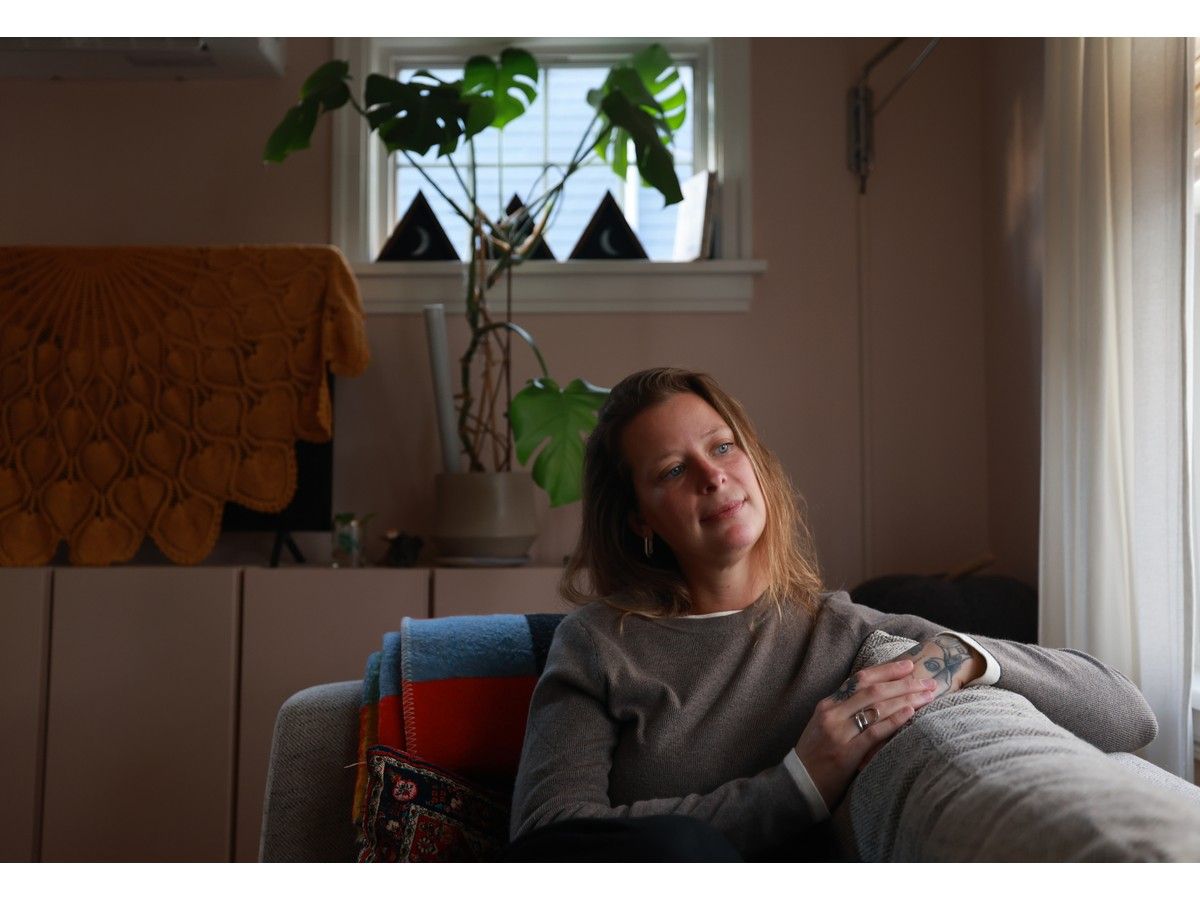
Abby Goodwin initially struggled to remember after her brain injury, but she recalls when a show at the Bus Stop Theatre captivated her imagination.
Roughly three years after being hit by a car, Goodwin moved to Halifax and started attending shows hosted by Hello City, a local improv group, at the Gottingen Street theatre. She’d spent hours relearning how to walk, how to talk and how to eat. Doing something for herself — whether she knew it or not — was the next step in her recovery.
“I would sit in the audience and I would watch them and they were having so much fun up there and I thought: ‘Man, I want to have fun like that,'” Goodwin told The Chronicle Herald. “It’s not singular, it’s not isolated, it’s togetherness.”
Inspired, she signed up for improv lessons at Neptune Theatre and worked with her recovering brain in a new way.
“I experienced how challenging improv can be, especially for your brain and cognition. Not only is this really challenging for me, I can feel my brain working and new neural pathways being built and opening up. This is fun. This is something I can do with people.”
That feeling of togetherness, of building, is something Goodwin has found in improv and in her life. But it comes after the brain injury that left her with symptoms she still struggles with.
Goodwin decided to go on a weekend trip to visit friends in Ottawa in 2016. However, while there, she was hit by a car and diagnosed with a “catastrophic” head injury that left her in a coma for a week.
When she woke up, she was airlifted to a hospital in Toronto to begin her rehabilitation and a life she never envisioned.
“There I was, 26 years old, learning everything over again.”
She said that once she regained some of those basic skills, she was sent home to live with her parents in Ajax, Ont. There, she began a rigorous two-year routine of physiotherapy, speech therapy and occupational therapy Monday to Friday.
Her job, she said, was to get better.
But her injury affected all parts of her life, leaving her with questions about what she was doing with herself and coming to terms with the accident.
She initially had serious memory loss and extreme cognitive fatigue. Her bandwidth was small, her ability to recharge even smaller.
Goodwin credits her friends and family for helping her get through an isolating part of her life.
“I really have an amazing support system around me. Not only my mother and my father, but I have some really great friends I can call on, the Brain Injury Association of Nova Scotia, my local yoga studio. These are the things that help me find who I am again and help me navigate the challenging moments I have.”
Cape Breton Eagles to file complaint with QMJHL after on-ice incident against Newfoundland Regiment
 Cape Breton
Promising football player from Halifax dies at U.S. boarding school
 Halifax
RCMP charges man following numerous crimes targeting communities in southwest Nova Scotia
 Annapolis Valley
Bobcat makes unexpected visit to Dartmouth backyard
 Halifax
Fundraiser started to support family of Antigonish County farmer who died in tractor collision
 Nova Scotia

Developing her own programming
Goodwin moved to Halifax around Christmas 2019.
She remembers attending her first Brain Injury Association of Nova Scotia (BIANS) event.
Many survivors feel isolated but Goodwin said the support and programming available through BIANS instantly made her feel seen.
“Coming here to Nova Scotia, the sheer engagement and number of programs (BIANS) had felt so accessible and felt so interesting to me and was totally in alignment with where I was when I moved to the province,” she said.
Emma Folkins, executive director of the association, said the organization tries to meet people where they are, as the spectrum of brain injuries and how people deal with them vary widely.
“We try to keep our programming as open, as flexible, and as adaptable as possible to individuals with acquired brain injury,” Folkins told The Chronicle Herald.
“We understand that people are coming to us in different stages of their recovery process. We know that recovery can take a lifetime, as well. Recovery isn’t linear. One day someone could be feeling strong and capable of doing something that they haven’t done in a long time and the next day they could be suffering from chronic fatigue, dizziness, there’s so many different symptoms.”
Goodwin approached BIANS last year looking to build a program around improv and therapy-based practices like mindfulness.
Folkins said Goodwin’s program, Therapeutic Play, is unlike any other she’s seen in its community impact and shape.
“We would laugh, we would cry, we would share stories together,” she said. “This is a program we’d meet with on a monthly basis with community members, it’d be in person, and she’d lead this great collaborative improv group where different scenarios would pop up and take people out of their comfort zones.”
Creating a lifestyle and routine around the brain
Goodwin said she understands how far she’s come in the 10 years since her accident. She lives independently in her own house in Halifax’s north end. Last year, she traveled to London, England for an improv course, which further tested her creative muscles. She’s found joy in offering up herself through her advocacy for BIANS and art.
But that isn’t to take away how hard things can still be. She needs to live a particular way to prevent fatigue clouding her mind.
“I’ve become quite good at creating a lifestyle and routine that prevents that from happening. But when it does, my speech will become slurred, I’ll be more irritable and have trouble processing information and problem solving.”
She knows her recovering brain well enough to take a step back when she needs it. It’s all part of a brain injury survivor’s reality.
“I’m offering my skills and offering my talents to the world in a way that feels good. I’m helping others, I’m exploring and I’m having fun, man,” said Goodwin.
“I’m really grateful for this second chance.”


 Pinterest
 Tumblr